
instantdb / instant
Instant is the best backend for AI-coded apps. You get auth, permissions, storage, presence, and streams — everything you need to ship apps your users will love.
description README.md



Get Started · Examples · Try the Demo · Docs · Discord
Instant is the best backend for AI-coded apps. You get auth, permissions, storage, presence, and streams — everything you need to ship apps your users will love.
You write relational queries in the shape of the data you want and Instant handles all the data fetching, permission checking, and offline caching. When you change data, optimistic updates and rollbacks are handled for you as well. Plus, every query is multiplayer by default.
We also support ephemeral updates, like cursors, or who's online. Currently we have SDKs for Javascript, React, and React Native.
How does it look? Here's a barebones chat app in about 12 lines:
// ༼ つ ◕_◕ ༽つ Real-time Chat
// ----------------------------------
// * Updates instantly
// * Multiplayer
// * Works offline

import { init, id } from "@instantdb/react";

const db = init({
  appId: process.env.NEXT_PUBLIC_APP_ID,
});

function Chat() {
  // 1. Read
  const { isLoading, error, data } = db.useQuery({
    messages: {},
  });

  // 2. Write
  const addMessage = (message) => {
    db.transact(db.tx.messages[id()].update(message));
  };

  // 3. Render!
  return <UI data={data} onAdd={addMessage} />;
}
Want to see for yourself? try a demo in your browser.
Motivation
Writing modern apps is full of schleps. Most of the time you start with the server: stand up databases, caches, ORMs, and endpoints. Then you write client-side code: stores, selectors, mutators. Finally you paint a screen. If you add multiplayer you need to think about stateful servers, and if you support offline mode, you need to think about IndexedDB and transaction queues.
To make things worse, whenever you add a new feature, you go through the same song and dance over and over again: add models, write endpoints, stores, selectors, and finally the UI.
Could it be better?
In 2021, we realized that most of the schleps we face as UI engineers are actually database problems in disguise. (We got into greater detail in this essay)
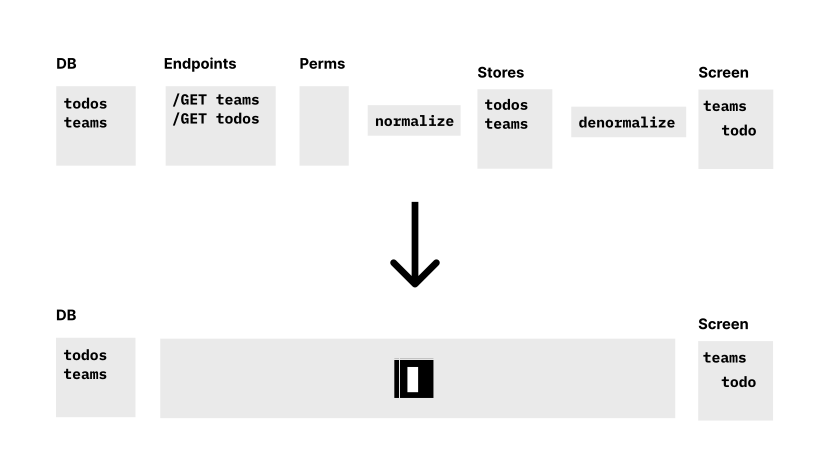
If you had a database on the client, you wouldn't need to think about stores, selectors, endpoints, or local caches: just write queries. If these queries were multiplayer by default, you wouldn't have to worry about stateful servers. And if your database supported rollback, you'd get optimistic updates for free.
So we built Instant. Instant gives you a database you can use in the client, so you can focus on what’s important: building a great UX for your users, and doing it quickly.
Architectural Overview
Here's how Instant works at a high level:
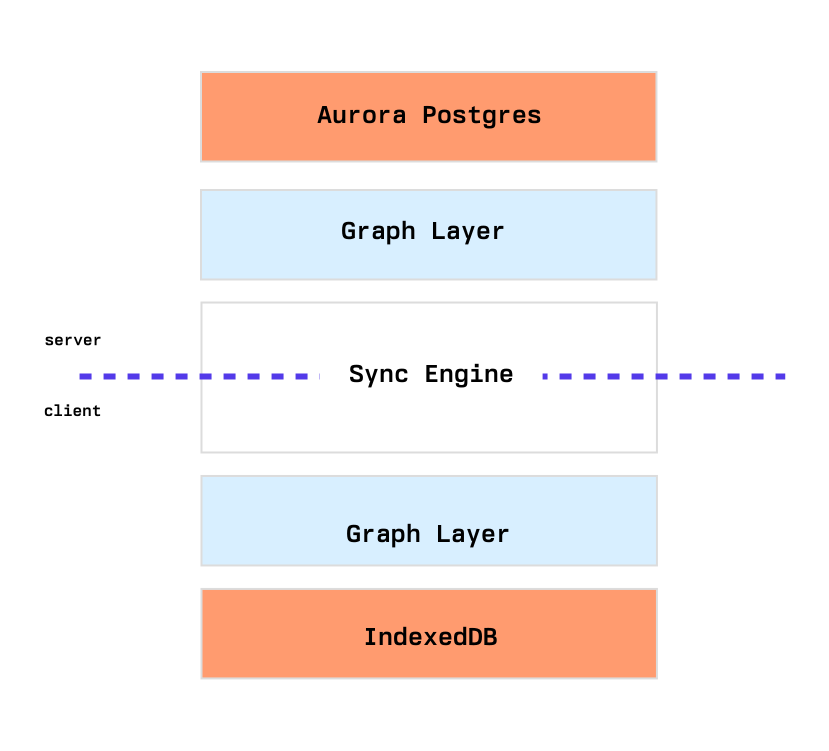
Under the hood, we store all user data as triples in one big Postgres database. A multi-tenant setup lets us offer a free tier that never pauses.
A sync server written in Clojure talks to Postgres. We wrote a query engine that understands datalog and InstaQL, a relational language that looks a lot like GraphQL:
// give me all users, their posts and comments
{
  users: {
    posts: {
      comments: {
      }
    }
  }
}
Taking inspiration from Asana’s WorldStore and Figma’s LiveGraph, we tail postgres’ WAL to detect novelty and invalidate relevant queries.
For the frontend, we wrote a client-side triple store. The SDK handles persisting a cache of recent queries to IndexedDB on web, and AsyncStorage in React Native.
All data goes through a permission system powered by Google's CEL library.
Getting Started
The easiest way to get started with Instant is by signing up on instantdb.com. You can create a functional app in 5 minutes or less.
If you have any questions, you can jump in on our discord.
Contributing
You can start by joining our discord and introducing yourself. Even if you don't contribute code, we always love feedback.
If you want to make changes, start by reading the client and server READMEs. There you'll find instructions to start Instant locally.
More in Uncategorized

openclaw / openclaw
OpenClaw is an open-source personal AI assistant that runs on your own devices and connects to the communication platforms you already use. It provides a fast, always-available assistant that can respond, listen, speak, and perform tasks across desktop and mobile devices.

obra / superpowers
An agentic skills framework & software development methodology that works.

mattpocock / skills
Created by renowned TypeScript educator Matt Pocock, Skills is a collection of practical, reusable workflows for AI coding agents such as Claude Code and Codex. The skills help developers plan, test, debug, and build real-world software while keeping control of the engineering process

affaan-m / everything-claude-code
The agent harness performance optimization system. Skills, instincts, memory, security, and research-first development for Claude Code, Codex, Opencode, Cursor and beyond.