
Lum1104 / Understand-Anything
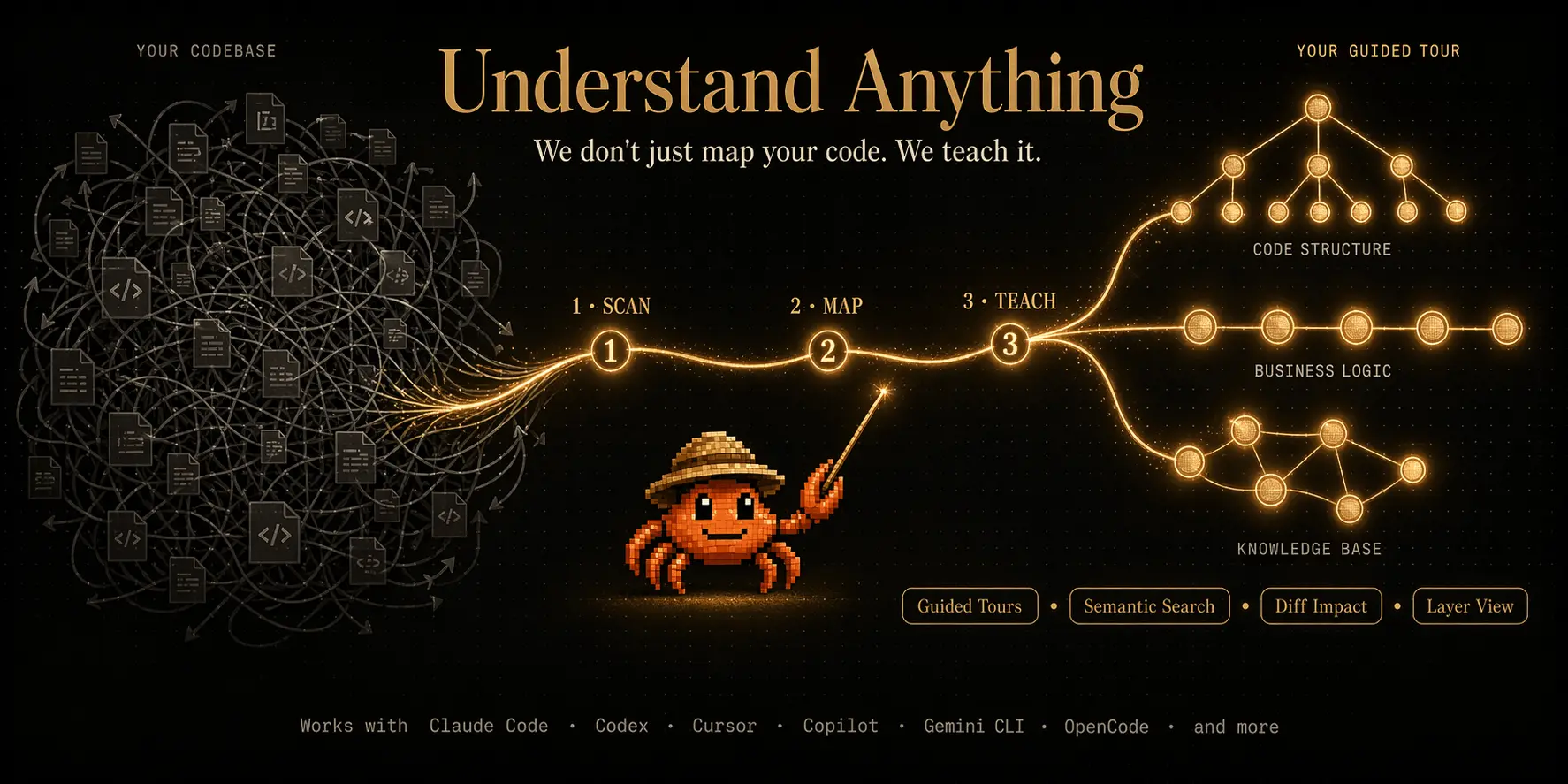
Graphs that teach > graphs that impress. Turn any code into an interactive knowledge graph you can explore, search, and ask questions about. Works with Claude Code, Codex, Cursor, Copilot, Gemini CLI, and more.
description README.md
Understand Anything
Turn any codebase, knowledge base, or docs into an interactive knowledge graph you can explore, search, and ask questions about.
Works with Claude Code, Codex, Cursor, Copilot, Gemini CLI, and more.
Understand Anything. Understand Anyone.
AI should help people, not replace them.
English | 简体中文 | 繁體中文 | 日本語 | 한국어 | Español | Türkçe | Русский | Tiếng Việt




You just joined a new team. The codebase is 200,000 lines of code. Where do you even start?
Understand Anything is a Claude Code Plugin that analyzes your project with a multi-agent pipeline, builds a knowledge graph of every file, function, class, and dependency, then gives you an interactive dashboard to explore it all visually. Stop reading code blind. Start seeing the big picture.
The goal isn't a graph that wows you with how complex your codebase is — it's a graph that quietly teaches you how every piece fits together.
✨ Features
[!NOTE] Want to skip the reading? Try the live demo in our homepage — a fully interactive dashboard you can pan, zoom, search, and explore right in your browser.
Explore the structural graph
Navigate your codebase as an interactive knowledge graph — every file, function, and class is a node you can click, search, and explore. Select any node to see plain-English summaries, relationships, and guided tours.
Understand business logic
Switch to the domain view and see how your code maps to real business processes — domains, flows, and steps laid out as a horizontal graph.
Analyze knowledge bases
Point /understand-knowledge at a Karpathy-pattern LLM wiki and get a force-directed knowledge graph with community clustering. The deterministic parser extracts wikilinks and categories from index.md, then LLM agents discover implicit relationships, extract entities, and surface claims — turning your wiki into a navigable graph of interconnected ideas.
🧭 Guided ToursAuto-generated walkthroughs of the architecture, ordered by dependency. Learn the codebase in the right order. |
🔍 Fuzzy & Semantic SearchFind anything by name or by meaning. Search "which parts handle auth?" and get relevant results across the graph. |
📊 Diff Impact AnalysisSee which parts of the system your changes affect before you commit. Understand ripple effects across the codebase. |
🎭 Persona-Adaptive UIThe dashboard adjusts its detail level based on who you are — junior dev, PM, or power user. |
🏗️ Layer VisualizationAutomatic grouping by architectural layer — API, Service, Data, UI, Utility — with color-coded legend. |
📚 Language Concepts12 programming patterns (generics, closures, decorators, etc.) explained in context wherever they appear. |
🚀 Quick Start
1. Install the plugin
/plugin marketplace add Egonex-AI/Understand-Anything
/plugin install understand-anything
Using a local model? For privacy or enterprise setups, point your platform at a local model provider such as Ollama — follow their integration guide to change the model provider.
2. Analyze your codebase
/understand
A multi-agent pipeline scans your project, extracts every file, function, class, and dependency, then builds a knowledge graph saved to .ua/knowledge-graph.json. (Projects that already have a .understand-anything/ directory keep using it — it stays the data directory when present, so nothing needs migrating.)
Heads up on token usage: The initial
/understandanalyzes your whole codebase and can consume a significant number of tokens on large projects. We recommend running it on a token plan / subscription, or using a local model (see above) for initialization. Subsequent runs are incremental by default — only changed files are re-analyzed — so they use far fewer tokens.
Localized output: Use --language to generate content in your preferred language:
# Generate Chinese content (知识图节点描述和 Dashboard UI)
/understand --language zh

# Supported languages: en (default), zh, zh-TW, ja, ko, ru, vi
On the first run in a project — when you don't pass --language and no language is stored yet — /understand detects the language you're conversing in. If it isn't English, it asks you to confirm (or override) before generating; English conversations are unaffected. Your choice is saved to .ua/config.json and reused on every later run.
The --language parameter affects:
- Node summaries and descriptions in the knowledge graph
- Dashboard UI labels, buttons, and tooltips
- Guided tour explanations
3. Explore the dashboard
/understand-dashboard
An interactive web dashboard opens with your codebase visualized as a graph — color-coded by architectural layer, searchable, and clickable
More in Uncategorized

openclaw / openclaw
OpenClaw is an open-source personal AI assistant that runs on your own devices and connects to the communication platforms you already use. It provides a fast, always-available assistant that can respond, listen, speak, and perform tasks across desktop and mobile devices.

obra / superpowers
An agentic skills framework & software development methodology that works.

mattpocock / skills
Created by renowned TypeScript educator Matt Pocock, Skills is a collection of practical, reusable workflows for AI coding agents such as Claude Code and Codex. The skills help developers plan, test, debug, and build real-world software while keeping control of the engineering process

affaan-m / everything-claude-code
The agent harness performance optimization system. Skills, instincts, memory, security, and research-first development for Claude Code, Codex, Opencode, Cursor and beyond.